The question of how humans process the flood of electronic media was a central part of the work of Stanford University sociology professor Clifford Nass, who died recently. Citing multiple studies, Nass said people often overestimate their ability to multitask.
iStockphoto.com
The question of how humans process the flood of electronic media was a central part of the work of Stanford University sociology professor Clifford Nass, who died recently. Citing multiple studies, Nass said people often overestimate their ability to multitask.
iStockphoto.com
Clifford Nass, the Stanford University sociologist who helped pioneer studies that undermined ideas about multitasking, has died at age 55. The man who dedicated his career to thinking about how humans live in a digital age died after taking part in a hike near Lake Tahoe Saturday.
At Stanford, Nass was "a larger than life character," his colleague professor Byron Reeves tells NPR's All Things Considered. Reeves says Nass "was just incredibly enthusiastic about his work, about students."
As for Nass' legacy, Reeves says his colleague worked to trace how technology has moved "from tools to social actors," in which everything from robots and computer-laden cars can now use interactive software to present visual cues.
"These were essentially social responses," Reeves says. "And humans were built for those kinds of social responses, and to recognize that kind of social interaction and to participate... and they did."
A graduate of Princeton University with degrees in mathematics and sociology, Nass worked as a computer scientist at Intel Corp. before beginning his work at Stanford, according to the Stanford Report. The school paper adds, "He was also a professional magician."
Nass's work on multitasking was just one part of how he examined the way people interact with technology. He also wrote books about voice recognition software, and the ways people think about computers and television.
But it was his research — and his skepticism — about multitasking that drew the most notice. And Nass didn't have to look far for test subjects.
"The top 25 percent of Stanford students are using four or more media at one time whenever they're using media," he told NPR's Science Friday this past May. "So when they're writing a paper, they're also Facebooking, listening to music, texting, Twittering, et cetera. And that's something that just couldn't happen in previous generations even if we wanted it to."
To anyone who claims they're able to multitask, to concentrate on multiple things at once while still thinking creatively and using their memory, Nass had a ready response.
"They're basically terrible at all sorts of cognitive tasks, including multitasking," he told Science Friday's Ira Flatow, citing a raft of scientific research. In Nass's view, people who say they're good at multitasking because they do it all the time are like smokers who say they've always smoked — so it can't be bad form them.
"People who multitask all the time can't filter out irrelevancy. They can't manage a working memory. They're chronically distracted," Nass said. "They initiate much larger parts of their brain that are irrelevant to the task at hand. And even - they're even terrible at multitasking. When we ask them to multitask, they're actually worse at it. So they're pretty much mental wrecks."
Nass also warned that the mental strain of taking in an ever-increasing load of information through electronic media hasn't been fully realized.
"Companies now create policies that force their employees to multitask," he said, according to the Stanford Report. "It's an OSHA (Occupational Safety and Health Administration) problem. It's not safe for people's brains."
Another of Nass' experiments revolved around how people see virtual versions of themselves — particularly when given the option of giving themselves feedback. Here's how he explained the results of a study during a 2010 appearance on NPR:
"We've done studies, for example, in which... you take a test on a computer and the feedback is either given not only by your own voice but your own face, saying you did a good job or you did a bad job, or someone else has.
"And people not only thought they did better when they got feedback from their own voice, they thought their own face and voice was more intelligent, more likable, and in fact they remembered more of the positive and fewer of the negative comments."
FILE - In this Feb. 10, 2013 file photo, Chris Brown arrives at the 55th annual Grammy Awards, in Los Angeles. Brown on Wednesday Nov. 6, 2013, countersued a man who claimed the R&B singer injured him during a fight outside a recording studio earlier this year. Brown's suit seeks unspecified damages and claims Sha'keir Duarte punched and kicked him during the fight. (Photo by Jordan Strauss/Invision/AP, File)
LOS ANGELES (AP) — Chris Brown has countersued a man who accused the R&B star's entourage of attacking him outside a recording studio earlier this year.
The singer filed an assault and battery lawsuit Wednesday against Sha'keir Duarte, who claimed in an earlier suit that he was injured when a fight erupted between Brown and Frank Ocean's entourages in January outside a West Hollywood studio.
Duarte sued Brown in August and accused the singer of being the aggressor in the fight. Brown's countersuit however accuses Duarte of instigating the fight by pushing, kicking and punching the R&B singer and threatening to kill him.
Brown, 24, is seeking unspecified damages.
Duarte's attorney Joseph Porter III did not immediately return a phone message seeking comment.
No criminal charges were filed over the fight, but Brown may face criminal penalties after he was arrested last month in Washington, D.C. for allegedly punching a man outside a hotel.
Brown remains on probation for his 2009 attack on then-girlfriend Rihanna and is due for a hearing in Los Angeles on Nov. 20, during which the new case may be addressed. Brown spent a day and a half in custody and faces a misdemeanor battery charge over the incident.
The R&B singer entered rehab for anger management issues on Oct. 29.
In the new RoboCop trailer, Samuel L. Jackson claims that the American public refuses to have robots patrolling the streets. But when this happens in real life we shouldn't reject it, because it could be a great thing.
One man's sewage is another man's drinking water. This pipe, filled with straw-like filters, gets rid of the contaminants in __.
Amy Standen/KQED
One man's sewage is another man's drinking water. This pipe, filled with straw-like filters, gets rid of the contaminants in __.
Amy Standen/KQED
In California's Silicon Valley, there will soon be a new source of water for residents. That may not sound like big news, but the source of this water – while certainly high-tech — is raising some eyebrows.
With freshwater becoming more scarce in many parts of the country, the public may have to overcome its aversion to water recycling.
Ah, The Stench Of Drinking Water
If text could transmit odor, you'd already know where this water is coming from.
"Well, we happen to be very close to a landfill," says Marty Grimes, a spokesman for the brand-new $68 million Silicon Valley Advanced Water Purification Center in San Jose.
There's also a wastewater treatment plant across the street. And that is where this water comes from: a place that smells a lot like a toilet.
This hydrant carries __ water to/from the treatment plant.
Amy Standen/KQED
This hydrant carries __ water to/from the treatment plant.
Amy Standen/KQED
"Wastewater is not necessarily a pretty business," says Grimes. "But let me tell you, the result of our plant is going to be pure, clean water."
It's a little unfair to linger on the unsavory sewage source. When this plant starts up later this year, it will be doing some of the most state-of-the-art water filtration in the country.
Naturally, that's what engineers here emphasize when they give tours.
"The water comes from the autostrainers, where it's strained down to 300 microns," says Crystal Yezman, who works at the facility. One micron is one thousandth of a millimeter, so 300 microns is about the size of a human hair.
That's step one — filtering out everything wider than a human hair.
Finally, the water gets zapped by ultraviolet rays, which scramble the DNA of anything that might be living in it. This water is clean.
"The Department of Health has acknowledged that we are removing 99.99 percent of all pathogens," says Yezman.
If that's true, then the water is cleaner than snow melt, and certainly almost as good as what people get from their kitchen sinks now.
Or, says Grimes, "it could be even better."
Erasing A Dirty Past
Despite how clean this water is, no one's going to drink it. It's going into segregated pipes bound for landscaping instead.
But that may have to change one day because, like a lot of places in the West, water supplies here are drying up. Recycled water is the future — if enough people can be convinced that it's OK to drink.
"You have to break the memory, or the line of history, of the water," explains Brent Haddad of the University of California, Santa Cruz.
This is not an engineering challenge, he says. It's a psychological challenge. Water managers, he says, need to rewrite the history of the water to help people forget the part about sewage.
One way to do this is to take recycled water and put it back into a natural setting, like a river.
A "river is something that's comforting to people," says Haddad. "And we don't have to think anymore that it was passing through a city. We just begin the history of that water in the river itself."
Nine Years Of Convincing
This, of course, happens in nature every day. Just look at the Mississippi River — it's full of treated sewage water that people downstream clean and then drink.
And it's happening in Southern California, home to the largest potable water recycling facility in the world.
"We put it back into the ground, and then eventually it becomes part of the water supply," says Mike Markus, general manager of the facility.
Instead of putting their water into a river, his district cleans treated sewage and then pumps it underground, where it mixes with other water. Then, they pump it back up and treat it all over again, before piping it to peoples' houses.
Even with this crazy, Rube Goldbergian system, getting the public to accept recycled water took lots of meetings.
Markus says he and his colleagues talked to almost anyone who would listen — local elected officials, the health and medical community, the chamber of commerce, schools, environmentalists, rotary groups.
"We talked to the Sons and Daughters of the American Revolution. And scouting troops," Markus adds. "Anyone who would want to hear or receive a presentation."
That whole process took nine years.
The irony, of course, is that when you put recycled water back into the ecosystem, it actually gets dirtier and has to be treated again. How does it feel to put that beautiful clean water into a hole in the ground? "Frustrated," Markus says.
So, he reminds himself that winning people over to recycled sewage water is a process — one that's just beginning here in Silicon Valley.
New method predicts time from Alzheimer's onset to nursing home, death
PUBLIC RELEASE DATE:
7-Nov-2013
[
| E-mail
]
Share
Contact: Elizabeth Streich eas2125@cumc.columbia.edu 212-305-3689 Columbia University Medical Center
Draws on information from a single patient visit
NEW YORK, NY (Nov. 7, 2013) A Columbia University Medical Center-led research team has clinically validated a new method for predicting time to full-time care, nursing home residence, or death for patients with Alzheimer's disease. The method, which uses data gathered from a single patient visit, is based on a complex model of Alzheimer's disease progression that the researchers developed by consecutively following two sets of Alzheimer's patients for 10 years each. The results were published online ahead of print in the Journal of Alzheimer's Disease.
"Predicting Alzheimer's progression has been a challenge because the disease varies significantly from one person to anothertwo Alzheimer's patients may both appear to have mild forms of the disease, yet one may progress rapidly, while the other progresses much more slowly," said senior author Yaakov Stern, PhD, professor of neuropsychology (in neurology, psychiatry, and psychology and in the Taub Institute for Research on Alzheimer's Disease and the Aging Brain and the Gertrude H. Sergievsky Center) at CUMC. "Our method enables clinicians to predict the disease path with great specificity."
"Until now, some methods of predicting the course of Alzheimer's have required data not obtained in routine clinical practice, such as specific neuropsychological or other measurements, and have been relatively inaccurate. This method is more practical for routine use," said Nikolaos Scarmeas, MD, a study co-author and associate professor of neurology, in the Taub Institute and the Sergievsky Center. "It may become a valuable tool for both physicians and patients' families."
The new method also may be used in clinical trialsto ensure that patient cohorts are balanced between those with faster-progressing Alzheimer's and those with slower-progressing diseaseand by health economists to predict the economic impact of Alzheimer's disease.
The prediction method is based on a Longitudinal Grade of Membership (L-GoM) model, developed by a research team also led by Dr. Stern and published in 2010.
The L-GoM includes 16 sets of variables, such as ability to participate in routine day-to-day activities; mental status; motor skills; estimated time of symptom onset; and duration of tremor, rigidity, or other neurological symptoms. It also includes data obtained postmortem (time and cause of death).
"The benefit of the L-GoM model is that it takes into account the complexity of Alzheimer's disease. Patients don't typically fall neatly into mild, moderate, or severe disease categories. For example, a patient may be able to live independently yet have hallucinations or behavioral outbursts," said Dr. Stern, who also directs the Cognitive Neuroscience Division at CUMC. "Our method is flexible enough to handle missing data. Not all 16 variables are needed for accurate predictionsjust as many as are available."
Results can be presented as expected time to a particular outcome. Two 68-year-old Alzheimer's patients, for example, had similar mental status scores (one a mini-mental status score (mMMS) of 38/54, the other of 39/54) at initial visit. The first patient was more dependent on his caregiver and had psychiatric symptoms (delusions). These and other subtle differences in the initial presentation of the two patients resulted in different predictions of time until death. The method accurately predicted that the first patient would die within three years, while the other would survive more than 10 years.
"In addition to time to nursing home residence or death, our method can be used to predict time to assisted living or other levels of care, such as needing help with eating or dressing, or time to incontinence," said first author Ray Razlighi, PhD, assistant professor of neurology at CUMC and adjunct assistant professor of biomedical engineering at Columbia University.
Development of the method began in 1989, when Dr. Stern received a grant from the National Institutes of Health to begin the Predictors of Severity in Alzheimer's Disease study. "The fact that work on this prediction method began nearly 25 years ago underlines the difficulties of studying Alzheimer's disease," said Richard Mayeux, MD, MS, neurology chair, the Gertrude H. Sergievsky Professor of Neurology, Psychiatry and Epidemiology and co-director of the Taub Institute and the Sergievsky Center.
Dr. Stern and colleagues at Massachusetts General Hospital and Johns Hopkins first followed 252 non-familial Alzheimer's patients every six months for 10 years. Eric Stallard, an actuary at Duke and a co-author of the paper, used the resultant data to create an L-GoM model of Alzheimer's progression. They published their results in 2010 in Medical Decision Making. The researchers then followed a separate group of 254 patients and used data from only a single patient visit to predict outcomes for this group.
Dr. Stern and his team are now developing a computer program that would allow clinicians to input the variables and receive a report. They expect the program to become available within the next two years. Eventually, such a program might be incorporated into electronic health records. "At our Alzheimer's center, patients are already filling out much of their clinical information electronically," said Dr. Stern.
The researchers are also testing the method with a third cohort. While the first two sets of patients were primarily white, educated, and of high socioeconomic status, the new cohort follows a diverse group of participants from CUMC's Washington Heights-Inwood Columbia Aging Project (WHICAP), an ongoing, community-based study of aging and dementia comprising elderly, urban-dwelling residents. Because participants may be dementia-free when they join the study, the researchers are able to capture the age of dementia onset and track symptom development over time.
###
The paper is titled, "A New Algorithm for Predicting Time to Disease Endpoints in Alzheimer's Disease Patients." The method's formula is detailed in supplementary material for the paper. The other contributors are: Anatoliy I. Yashin (Duke); Jason Brandt and Marilyn Albert (Johns Hopkins); Deborah Blacker (Massachusetts General Hospital/Harvard); and Bruce Kinosian (Philadelphia VA Medical Center).
The study was supported by a grant to Dr. Stern from the National Institute on Aging (R01 AG007370). The authors declare no financial or other conflicts of interest.
The Taub Institute for Research on Alzheimer's Disease and the Aging Brain at Columbia University Medical Center is a multidisciplinary group that has forged links between researchers and clinicians to uncover the causes of Alzheimer's, Parkinson's, and other age-related brain diseases and discover ways to prevent and cure these diseases. It has partnered with the Gertrude H. Sergievsky Center at Columbia University Medical Center, which was established by an endowment in 1977 to focus on diseases of the nervous system, and with the Departments of Pathology & Cell Biology and of Neurology to allow the seamless integration of genetic analysis, molecular, and cellular studies and clinical investigation to explore all phases of diseases of the nervous system. For more information visit The Taub Institute at http://www.cumc.columbia.edu/dept/taub/.
Columbia University Medical Center provides international leadership in basic, preclinical, and clinical research; medical and health sciences education; and patient care. The medical center trains future leaders and includes the dedicated work of many physicians, scientists, public health professionals, dentists, and nurses at the College of Physicians and Surgeons, the Mailman School of Public Health, the College of Dental Medicine, the School of Nursing, the biomedical departments of the Graduate School of Arts and Sciences, and allied research centers and institutions. Columbia University Medical Center is home to the largest medical research enterprise in New York City and State and one of the largest faculty medical practices in the Northeast. For more information, visit cumc.columbia.edu or columbiadoctors.org.
[
| E-mail
Share
]
AAAS and EurekAlert! are not responsible for the accuracy of news releases posted to EurekAlert! by contributing institutions or for the use of any information through the EurekAlert! system.
New method predicts time from Alzheimer's onset to nursing home, death
PUBLIC RELEASE DATE:
7-Nov-2013
[
| E-mail
]
Share
Contact: Elizabeth Streich eas2125@cumc.columbia.edu 212-305-3689 Columbia University Medical Center
Draws on information from a single patient visit
NEW YORK, NY (Nov. 7, 2013) A Columbia University Medical Center-led research team has clinically validated a new method for predicting time to full-time care, nursing home residence, or death for patients with Alzheimer's disease. The method, which uses data gathered from a single patient visit, is based on a complex model of Alzheimer's disease progression that the researchers developed by consecutively following two sets of Alzheimer's patients for 10 years each. The results were published online ahead of print in the Journal of Alzheimer's Disease.
"Predicting Alzheimer's progression has been a challenge because the disease varies significantly from one person to anothertwo Alzheimer's patients may both appear to have mild forms of the disease, yet one may progress rapidly, while the other progresses much more slowly," said senior author Yaakov Stern, PhD, professor of neuropsychology (in neurology, psychiatry, and psychology and in the Taub Institute for Research on Alzheimer's Disease and the Aging Brain and the Gertrude H. Sergievsky Center) at CUMC. "Our method enables clinicians to predict the disease path with great specificity."
"Until now, some methods of predicting the course of Alzheimer's have required data not obtained in routine clinical practice, such as specific neuropsychological or other measurements, and have been relatively inaccurate. This method is more practical for routine use," said Nikolaos Scarmeas, MD, a study co-author and associate professor of neurology, in the Taub Institute and the Sergievsky Center. "It may become a valuable tool for both physicians and patients' families."
The new method also may be used in clinical trialsto ensure that patient cohorts are balanced between those with faster-progressing Alzheimer's and those with slower-progressing diseaseand by health economists to predict the economic impact of Alzheimer's disease.
The prediction method is based on a Longitudinal Grade of Membership (L-GoM) model, developed by a research team also led by Dr. Stern and published in 2010.
The L-GoM includes 16 sets of variables, such as ability to participate in routine day-to-day activities; mental status; motor skills; estimated time of symptom onset; and duration of tremor, rigidity, or other neurological symptoms. It also includes data obtained postmortem (time and cause of death).
"The benefit of the L-GoM model is that it takes into account the complexity of Alzheimer's disease. Patients don't typically fall neatly into mild, moderate, or severe disease categories. For example, a patient may be able to live independently yet have hallucinations or behavioral outbursts," said Dr. Stern, who also directs the Cognitive Neuroscience Division at CUMC. "Our method is flexible enough to handle missing data. Not all 16 variables are needed for accurate predictionsjust as many as are available."
Results can be presented as expected time to a particular outcome. Two 68-year-old Alzheimer's patients, for example, had similar mental status scores (one a mini-mental status score (mMMS) of 38/54, the other of 39/54) at initial visit. The first patient was more dependent on his caregiver and had psychiatric symptoms (delusions). These and other subtle differences in the initial presentation of the two patients resulted in different predictions of time until death. The method accurately predicted that the first patient would die within three years, while the other would survive more than 10 years.
"In addition to time to nursing home residence or death, our method can be used to predict time to assisted living or other levels of care, such as needing help with eating or dressing, or time to incontinence," said first author Ray Razlighi, PhD, assistant professor of neurology at CUMC and adjunct assistant professor of biomedical engineering at Columbia University.
Development of the method began in 1989, when Dr. Stern received a grant from the National Institutes of Health to begin the Predictors of Severity in Alzheimer's Disease study. "The fact that work on this prediction method began nearly 25 years ago underlines the difficulties of studying Alzheimer's disease," said Richard Mayeux, MD, MS, neurology chair, the Gertrude H. Sergievsky Professor of Neurology, Psychiatry and Epidemiology and co-director of the Taub Institute and the Sergievsky Center.
Dr. Stern and colleagues at Massachusetts General Hospital and Johns Hopkins first followed 252 non-familial Alzheimer's patients every six months for 10 years. Eric Stallard, an actuary at Duke and a co-author of the paper, used the resultant data to create an L-GoM model of Alzheimer's progression. They published their results in 2010 in Medical Decision Making. The researchers then followed a separate group of 254 patients and used data from only a single patient visit to predict outcomes for this group.
Dr. Stern and his team are now developing a computer program that would allow clinicians to input the variables and receive a report. They expect the program to become available within the next two years. Eventually, such a program might be incorporated into electronic health records. "At our Alzheimer's center, patients are already filling out much of their clinical information electronically," said Dr. Stern.
The researchers are also testing the method with a third cohort. While the first two sets of patients were primarily white, educated, and of high socioeconomic status, the new cohort follows a diverse group of participants from CUMC's Washington Heights-Inwood Columbia Aging Project (WHICAP), an ongoing, community-based study of aging and dementia comprising elderly, urban-dwelling residents. Because participants may be dementia-free when they join the study, the researchers are able to capture the age of dementia onset and track symptom development over time.
###
The paper is titled, "A New Algorithm for Predicting Time to Disease Endpoints in Alzheimer's Disease Patients." The method's formula is detailed in supplementary material for the paper. The other contributors are: Anatoliy I. Yashin (Duke); Jason Brandt and Marilyn Albert (Johns Hopkins); Deborah Blacker (Massachusetts General Hospital/Harvard); and Bruce Kinosian (Philadelphia VA Medical Center).
The study was supported by a grant to Dr. Stern from the National Institute on Aging (R01 AG007370). The authors declare no financial or other conflicts of interest.
The Taub Institute for Research on Alzheimer's Disease and the Aging Brain at Columbia University Medical Center is a multidisciplinary group that has forged links between researchers and clinicians to uncover the causes of Alzheimer's, Parkinson's, and other age-related brain diseases and discover ways to prevent and cure these diseases. It has partnered with the Gertrude H. Sergievsky Center at Columbia University Medical Center, which was established by an endowment in 1977 to focus on diseases of the nervous system, and with the Departments of Pathology & Cell Biology and of Neurology to allow the seamless integration of genetic analysis, molecular, and cellular studies and clinical investigation to explore all phases of diseases of the nervous system. For more information visit The Taub Institute at http://www.cumc.columbia.edu/dept/taub/.
Columbia University Medical Center provides international leadership in basic, preclinical, and clinical research; medical and health sciences education; and patient care. The medical center trains future leaders and includes the dedicated work of many physicians, scientists, public health professionals, dentists, and nurses at the College of Physicians and Surgeons, the Mailman School of Public Health, the College of Dental Medicine, the School of Nursing, the biomedical departments of the Graduate School of Arts and Sciences, and allied research centers and institutions. Columbia University Medical Center is home to the largest medical research enterprise in New York City and State and one of the largest faculty medical practices in the Northeast. For more information, visit cumc.columbia.edu or columbiadoctors.org.
[
| E-mail
Share
]
AAAS and EurekAlert! are not responsible for the accuracy of news releases posted to EurekAlert! by contributing institutions or for the use of any information through the EurekAlert! system.
One day Neil Gaiman will rule everything. I’ve seen it in the stars. I’ve foretold it in tea leaves. I heard about it at GDC Next 2013 in Los Angeles on Thursday.
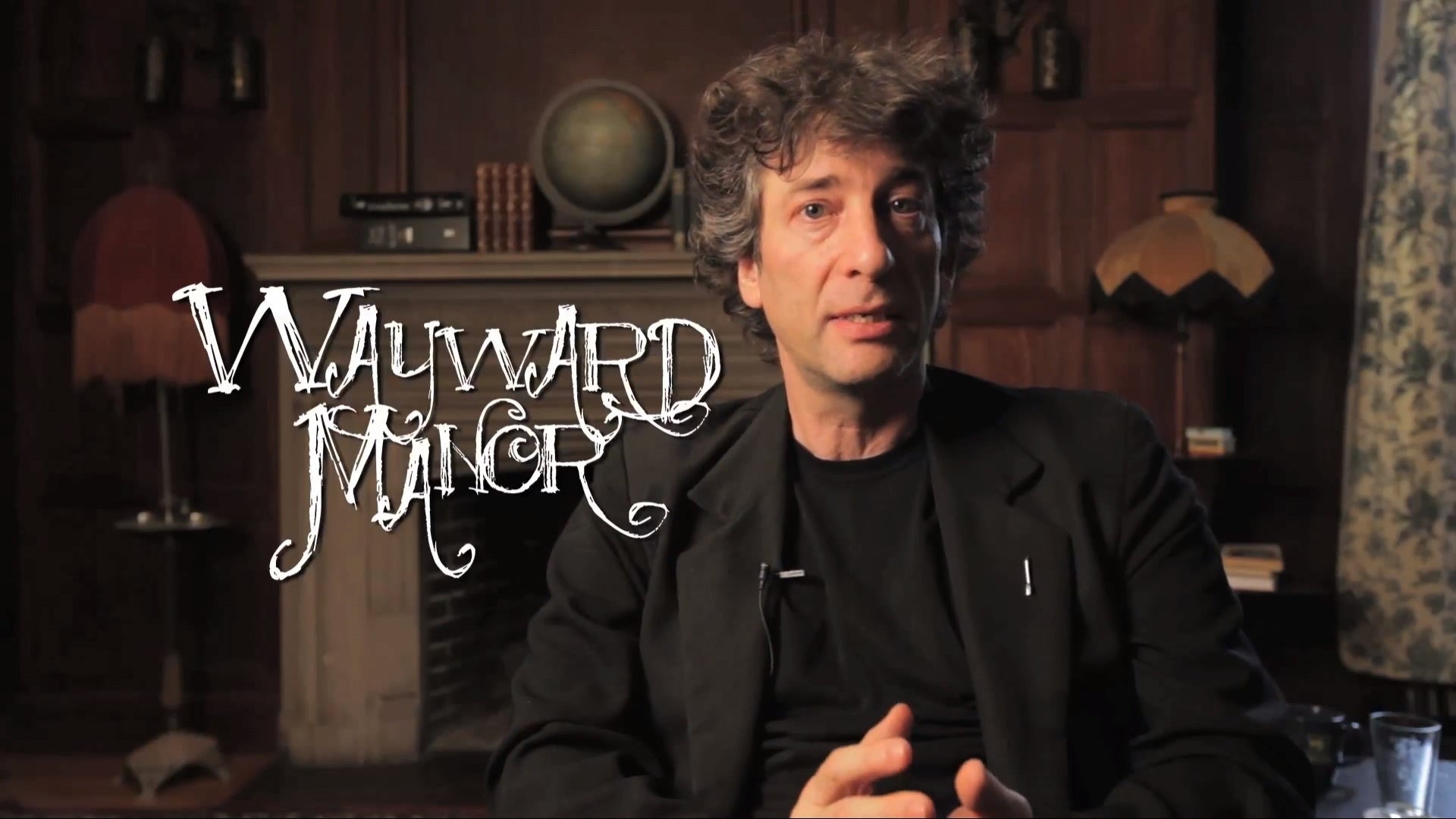
Gaiman, author of novels like American Gods and Coraline, is involved on a new game entitled Wayward Manor, in collaboration with The Odd Gentlemen, developer of critically-acclaimed game The Misadventures of P.B. Winterbottom.
Ghost in the house
Wayward Manor is a puzzle and adventure game, built in the style of classic Hollywood whodunits. You’re a ghost—more akin to Beetlejuice than Casper the Friendly Ghost. Your goal is to drive a bunch of obnoxious residents from your home by exploiting their fears, uncovering the truth behind the mansion in the process.
“We wanted to blend game mechanics and story together through play,” says Matt Korba, co-founder of The Odd Gentlemen, during his GDC Next talk. “[Neil] wasn’t really interested in coming in and being a writer for hire. The two of us have gone back and forth. Neil’s influenced the design, we’ve influenced the writing.”
The Odd Gentlemen claim Gaiman is doing more than just writing Wayward Manor.
“It was very obvious from the start that Neil respects games,” continued Korba. “He really understands the different needs of different medias.”
Most writers outside the game industry are used to a more linear or film-like format, even though games are fundamentally a choice-based narrative. This can be a huge detriment when writing game stories, as it tends to funnel players down a specific path.
According to Korba, Gaiman “got” games and understood what made the medium special.
There’s very little dialogue in Wayward Manor—in fact, Korba and the rest of the team are actively removing dialogue at this point to let Gaiman’s story shine through the interactive elements.
“A lot of people that want to get into games from Hollywood think it’s all about that cutscene and who cares whatever you’re doing in between those,” said Korba. “From the start, [Gaiman] was like, ‘We’re not going to tell the story through cutscenes. That’s boring. Nobody plays a game to watch cutscenes.’”
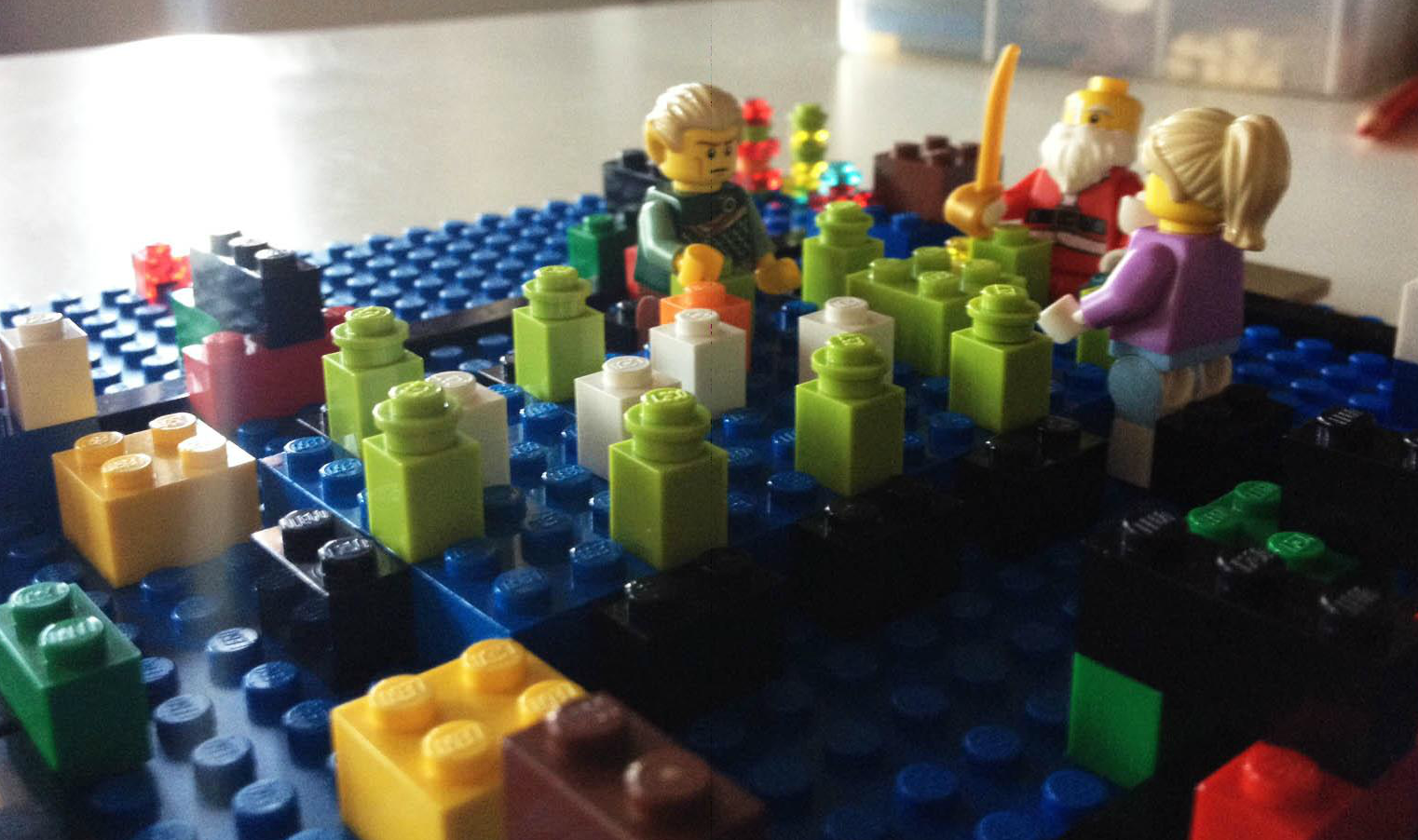
And it all started with a bunch of Lego blocks.
Building a game, brick by brick
“We’re really big on paper prototyping at the studio,” said Korba. “We think it’s a great way to share the experience early on and find out what makes the game work and not work and make changes really fast.”
Paper prototyping, as you might expect, involves physically building the basic elements of the game out of available materials, whether clay, toothpicks, Lego, or actual paper. What you end up with is something between a board game and a more abstract experience like Dungeons and Dragons.
Wayward Manor was built on a base of LEGO prototypes.
“We’d set up these levels in Lego, and it was color-coded and the bricks all corresponded to something in the game. A one-piece brick would be a level one object you could possess, a two-piece brick would be a level two object and so on,” said Korba.
“So we’d create these little scenes and then we would play them with people. We’d ask them what they would touch, and then we’d act out what would happen,” he continued.
The result? “We had this back and forth, fun little thing we could put on and show people and get to what we thought was the core of the game.”
And that’s what hooked Gaiman. Paper prototyping is just abstract enough to make a game fun even in the early days of development, when the actual digital prototype is still a garbled mess.
“When we’re talking about a collaboration with outside talent, it’s oftentimes easier for people to see the game and imagine where the game could go than showing them something digital,” said Korba. “Oftentimes when you show them something that’s very early digital it has temp art in it or it doesn’t have the proper sound or animation…and they can’t really see past that.”
“With a paper prototype, since it’s so abstract and a lot of times plays like a board game, you get people’s imaginations working and they can see where the game could go,” he continued.
We’re still a bit off from exploring Wayward Manor ourselves. Korba showed off some digital prototypes during his talk, but the full game won’t see release until next year.
In the meantime, maybe you should bust out that old Lego collection and try your hand at building your own games.
Miami Dolphins coach Joe Philbin talks to the media during a news conference after practice at the Dolphins training center in Davie, Fla., Wednesday, Nov. 6, 2013. NFL officials launched an investigation to try and determine who knew what and when about the troubled relationship between offensive lineman Richie Incognito and Jonathan Martin. (AP Photo/J Pat Carter)
Miami Dolphins coach Joe Philbin talks to the media during a news conference after practice at the Dolphins training center in Davie, Fla., Wednesday, Nov. 6, 2013. NFL officials launched an investigation to try and determine who knew what and when about the troubled relationship between offensive lineman Richie Incognito and Jonathan Martin. (AP Photo/J Pat Carter)
Miami Dolphins general manager Jeff Ireland, left, stands with head trainer Kevin O'Neill, right, during the NFL football team's practice Wednesday, Nov. 6, 2013, in Davie, Fla. (AP Photo/Lynne Sladky)
DAVIE, Fla. (AP) — In a culture that fosters conflict, Jonathan Martin sought to avoid it.
Upset by treatment he considered abusive, the Miami Dolphins tackle let the situation fester for months before leaving the team last week. Martin's agent then complained to the Dolphins, who suspended guard Richie Incognito.
The NFL is investigating whether Incognito harassed or bullied Martin, and whether their teammates and the organization mishandled the matter.
Some say Martin, a Stanford graduate who went about his business quietly, handled the situation well. But pro football is a macho world, and some players believe Martin should have responded more firmly.
"Is Incognito wrong? Absolutely. He's 100 percent wrong," New York Giants safety Antrel Rolle said. "No individual should have to go through that, especially in their workplace.
"But at the same time, Jonathan Martin is a 6-4, 320-pound man. I mean, at some point and time you need to stand your ground as an individual. Am I saying go attack, go fight him? No. I think we all understand we can stand our ground without anything being physical."
Dolphins players have robustly defended Incognito, long considered among the NFL's dirtiest players. He's now a notorious national villain, but teammates praise his leadership and loyalty.
They've been less passionate in their support of Martin, saying he and Incognito behaved like best friends.
"They did a lot of stuff together," tackle Tyson Clabo said. "So if he had a problem with the way he was treating him, he had a funny way of showing it."
Martin is with his family in California to undergo counseling for emotional issues.
A senior partner in a New York law firm was appointed by NFL Commissioner Roger Goodell to investigate possible misconduct and prepare a report. DeMaurice Smith, executive director of the NFL Players Association, said Thursday that he continues to be in touch with those involved.
"The NFLPA has taken steps to ensure that every one of our affected members is represented," Smith said in a statement. "It is our duty as a union to learn the full facts, protect the interests of players involved and hold management accountable to the highest standards of fairness and transparency."
The alleged bullying saga engulfing the Dolphins has shed a light on how damaging perceptions can be in the violent world of the NFL.
A Pittsburgh native, Martin is the son of Harvard graduates and his great grandfather also graduated from the school in 1924. At Stanford he protected Andrew Luck's blind side, and also majored in the classics.
Taken in the second round of the 2012 draft, Martin has what it takes physically to be an NFL player — size, skill, athleticism, intelligence. He won praise from the Dolphins for his diligent study of game and practice video.
But while has been a starter since the first game of his rookie season, Martin developed a reputation in the NFL for lacking toughness. That impression might have been reinforced by the way he handled his issues with Incognito, current and former teammates acknowledge.
"A lot of people might look at Jonathan Martin and think that he's soft because he stepped away from the game, and say, 'Why don't you just fight him?'" said Seattle Seahawks receiver Doug Baldwin, who played with Martin at Stanford. "Well, if you look at it with common sense and being logical, what options did Jonathan Martin have?
"He could fight Richie Incognito. He could go and tell on the players, which we know in the football locker room doesn't go over too well. Or he could remove himself from the situation and let the proper channels take care of itself. And I think he made the intelligent, smart choice without putting himself or Richie Incognito's physical abilities in danger."
Houston Texans Antonio Smith, who has accused Incognito of dirty play since they went against each other in college, said Martin should have responded more forcefully. Smith drew a three-game suspension this year for taking Incognito's helmet and hitting him during an exhibition game.
"I don't think that in my opinion a grown man should get bullied," Smith said. "And I think that if you're realistically getting bullied, there's only one way my mom taught me and my dad taught me how to get rid of bullies. They used to always say, 'You hit a bully in the mouth. It will stop him from bullying, no matter what you hit him with.'"
Incognito's harassment of Martin included text messages that were racist and threatening, two people familiar with the situation have told The Associated Press. Incognito is white, while Martin is biracial.
Two other people familiar with the situation have said Martin talked of quitting football earlier in his pro career before leaving the Dolphins. One person said Martin considered giving up the sport because of the way he was being treated by other offensive linemen on the team. The person added that Martin now wants to continue his football career.
The Dolphins (4-4) play for the first time since the scandal broke Monday night at Tampa Bay (0-8). At least 75 reporters and cameramen tracking the case were in the locker room after Thursday's practice, but receiver Brian Hartline said the scrutiny won't prevent the team from playing well.
"It almost heightens your awareness," he said. "You know it's going to take away from your focus, so it does the exact opposite. You overcompensate to make sure you stay aware of the game."
___
AP Sports Writers Tim Booth in Seattle, Tom Canavan in East Rutherford, N.J., and Kristie Rieken in Houston contributed to this report.
___
AP NFL website: www.pro32.ap.org and http://twitter.com/AP_NFL
___
Follow Steven Wine on Twitter: http://twitter.com/Steve_Wine


 Source:
 ![[ Back to EurekAlert! ]](https://lh3.googleusercontent.com/blogger_img_proxy/AEn0k_tpb7ZHNaOOiqOT38g5H_HqgLGIQ3Gdt7G291rAG3o5C_LEIRxZpR2E-JUoopThkVFtDL_aeiWWiqpKVEJlRGGBGXXGiPrHldSUzIMzO_U=s0-d)
 Share
Share